


This companion piece to this week’s episode. The podcast is the full, unedited, and raw version; this is just the rundown of what I talked about.
You can listen to this episode on Spotify, and Apple Podcasts for audio only.
Today I record from Elfen Town, Eleven Dunbar’s virtual home! Below a little written recap from today’s episode.
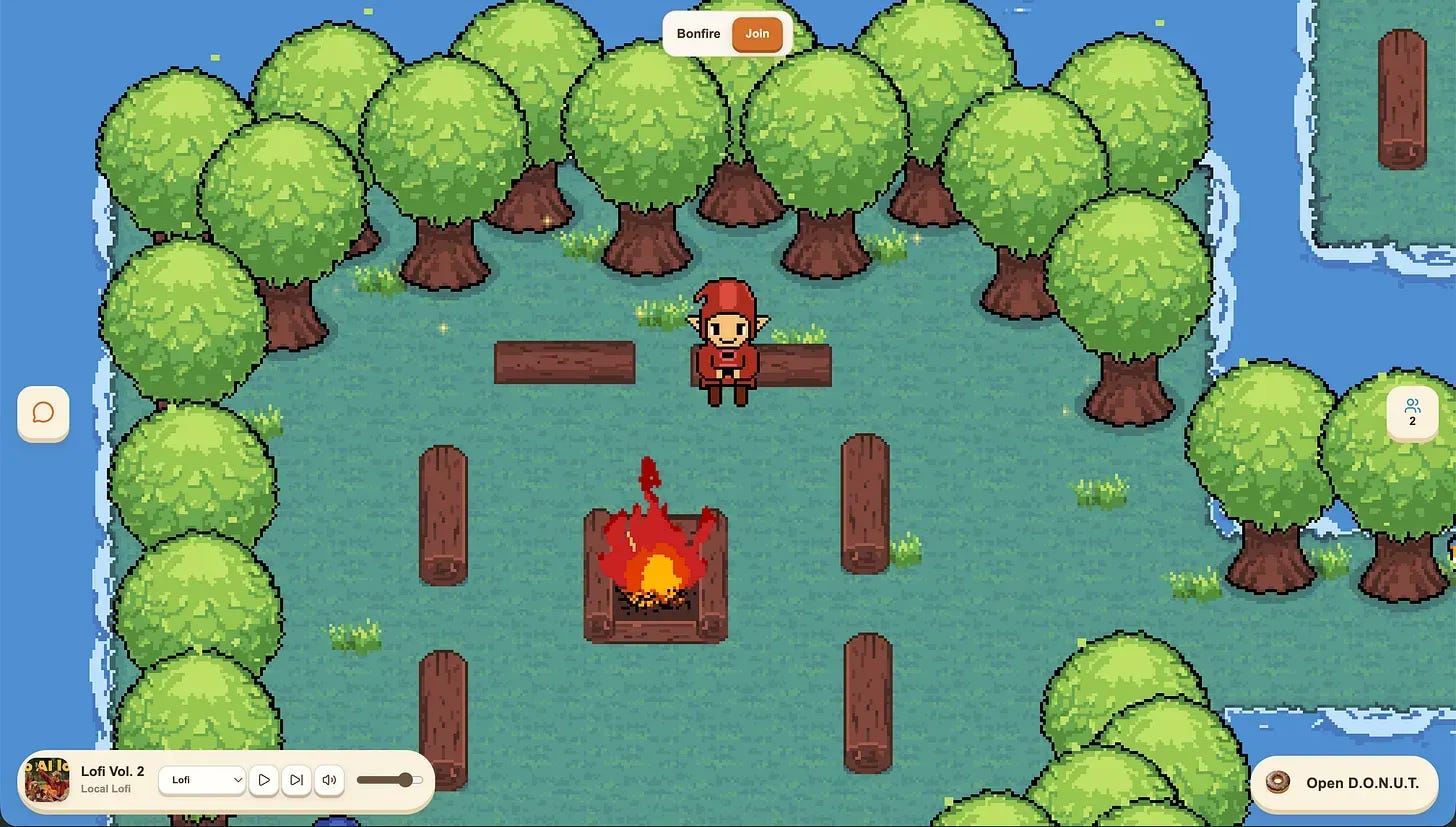
What we launched this week. Elfen Town is live, which is the 2D pixel virtual world we have been building for Eleven Dunbar, always on, where members can hang out, listen to music together, pick up quests, and find the Easter eggs we hid in it. We are a global and digital first community, so the question of where we gather is a real one, and this is our answer to it. Justin and I are also kicking off a new podcast this week, and I will share pictures and more in the coming weeks.
The chapter that got a reaction out of me. We read Atmamun in our Eleven Dunbar book club, which is short, and which I highly recommend, and there is a chapter in it called Human beings were not meant to be workers. It opens with the story of a lion cub who loses his way, falls in with a group of sheep, and becomes one, walking like them and making their sounds, until a lion finds him and takes him to a lake to look at his own reflection, at which point the cub sees what he is and begins to roar. Then it makes its argument, that a great deal of value is placed on having a job, that a man who labours in exchange for a paycheck is considered honourable mostly because we compare him against the man who does nothing, and that both of them have missed it. The line that landed hardest is that a job is an insult to a human being. The author includes himself in the accusation, which is what makes it possible to hear.
The corporate body. Somebody described this to me recently and I have not been able to unsee it, the particular way a body looks after years in a corporate environment, not heavy, just sluggish and stressed, built by waking up, sitting down for nine hours, and performing tasks that do not survive close inspection. I am not talking about doctors or teachers or anyone doing work that obviously matters. I mean the strange amount of money we pay people to do things that nobody, including them, could defend as useful.
What is actually missing. I keep meeting people at both ends of this, the ones with real material success and the ones still chasing it, and the thing underneath both is the same, which is that what we want is not the next paycheck or the next promotion but freedom from the torment of our own mind. Inner peace, and coming back to our natural state, like a leaf carried on a river that does not have to work out where the river is going.
Money is not the problem, the attachment is. Jobs became this central in the space of about two hundred years because money became central, and money is a good thing and a useful vehicle, and the belief that we need it to survive is still not quite true, which you can see in the tribes who live in nature and want for nothing. The trouble is that money is infinite in a way nothing physical is, a number that can always go higher, so there is never a point at which it is enough, and we lost our sense of balance somewhere in that. What I try to practise instead is looking at my account and saying this is what I have today, and if it is gone tomorrow that is also fine, because it is the attachment that does the damage, along with the older attachment underneath it, the one where we quietly believe we are not going to die.

If you recognised yourself in this piece, you are not the only one. A lot of us get very good at achieving, performing, and solving problems for everyone else, and slowly lose track of our own voice along the way.
Eleven Dunbar is a private community of founders, dreamers, builders and artists who want to find that inner voice again, make real friendships, and bring their ideas into the world without doing it all alone.
Members meet weekly to create alongside each other, and across a season there are visiting artists, shared projects, small group conversations, and people who notice when you go quiet.
The community is capped at 150.
Ideas are entities. All three of the books I keep recommending say a version of this, that ideas come from a source and we are vessels, and Big Magic puts it best. Ideas float around and they choose you. When one knocks it is a full body reaction, something at the back of your neck, a sense that something just arrived. It does not belong to you, it has picked you as a possible collaborator, and it will wait a long time, months or years, and if it becomes clear that you are not going to answer then it moves on to somebody else, which is fair enough. They arrive through anything, a flash, a conversation, a person who acts as a conductor without knowing it, a sunset, one sentence in a book.
Why a soul would choose a body. This is where the two threads met for me. What if the human body is the peak of what nature has produced, the most remarkable thing evolution has managed, and a soul arrives and puts it on like a mega suit, precisely because this suit can receive. It gives you the emotions, the senses, the reality, all of which are the requirements for expressing anything at all, for becoming an artist and taking part in a story that has no agenda and runs on curiosity and experimentation. Seen that way the suit is not a vehicle for earning, it is an antenna, and the ability to catch something out of that invisible field and make it real is pure magic rather than chemistry.
And look at what we are doing to the suit. We fill it with hyper-processed food, we poison the environment it depends on, we sit it down for most of its waking hours, and we train it to ignore the heart in favour of the mind, when the mind was only ever meant to be the vehicle that carries the heart’s decisions out into the world. The suit still works, more or less. We just do not maintain it, and a badly maintained antenna receives less.
A chocolate review, at last. Zotter again, the Austrian company in Styria, and worth looking up if you do not know them, since they take no investment, source their cacao with real care, and produce something closer to art than confectionery. Two this time from one package, both 75 percent. The Madagascar has 22 hours of conching and is soft, nutty, creamy, with nougat in it, and it is the one I would hand to somebody who thinks they do not like dark chocolate. The Guatemala has 8 hours and is a completely different animal, acidic and popping and fruity with raisin in it, intriguing enough that I reached straight for a second piece and tiring by the third. The standings are now Zotter 80/20 in first, still my favourite chocolate on earth, Peru 82 percent in second, Madagascar third, Guatemala fourth.
The invitation. Walk around this week as though the invisible field is real. There is a layer we cannot see with our eyes, though the body and the heart seem to manage it, where ideas float around waiting to find someone, and if one knocks, notice the full body reaction and take it seriously, because that is the beginning of a relationship rather than a passing thought.
Thanks for reading - you can support my work by leaving a comment or sharing it.


