
The Honest Voice
On why creativity, genuine connection, and the impossible all start with knowing yourself


By Dr. Nicole Ohebshalom & Gerhard Molin

Dr. Nicole Ohebshalom and I hopped on a Zoom call to talk about playfulness and ended up somewhere else entirely: the honest voice. It was too good a conversation to keep to just the two of us, so we wanted to share a piece of it here.
We kept noticing that whatever the question actually is - how do I create something that matters, how do I love someone well, how do I stop performing and start living. In other words: how do I stop chasing fulfillment, joy, connection, and aliveness?
The answer keeps arriving at the same starting point, which is knowing yourself. For a long time, I found that a slightly unsatisfying answer, the kind of thing that sounds true in a workshop and empty again by Tuesday morning.
Until I started paying attention to what knowing yourself actually requires, which turns out to be something far more specific, and far more physical, than I expected.
It requires finding your honest voice.
And then trusting it enough to let it speak before you’ve fully worked out what it’s going to say.
1. What Is, and Isn’t, the Honest Voice
Gerhard Molin:
You’ve probably come across the word authentic somewhere along the way, in a caption, a keynote, a wellness app notification, and I’ve always had a hard time getting cozy with it, because it assumes there is a true self buried somewhere, already finished, just waiting to be excavated like something you’d find at a dig site.
Honest feels different. Less like an artifact and more like a verb. Something you do from moment to moment, not something you eventually locate and keep.
And here’s the part that surprised me most when I started paying attention to it: the honest voice isn’t a mental image, or a clever insight, or a piece of internal chatter you can reason your way toward. It’s a bodily feeling. It doesn’t know the why yet. It just knows it’s the right thing to do, the way your hand knows to pull back from something hot before your brain has finished explaining heat.
You already know this, even if you’ve never named it. There’s research that has looked at the literal voice of someone who is depressed against the voice of someone who feels alive, and the difference is measurable, not just felt1. You know it in your own life too. The moment your voice fully vibrates, it feels warm, and rich, and simply honest. And the moment you speak from somewhere else, it goes cold, produced, as if something is quietly blocking your throat.
That second voice leaves a faint aftertaste of performance, of trying to sound smarter, kinder, more certain, more whatever-it-is I’ve decided I need to be perceived as in this particular room.
It sounds rehearsed like a broken vinyl player - a perfect narrative you can reproduce over and over.
It just doesn’t feel honest. It feels less like speaking and more like managing.
The honest voice, by contrast, is less polished. Rawer. Unfiltered, in the way a kid is unfiltered before anyone’s told them not to be.
Your honest voice doesn’t know performance; it will tell the same story in many ways, whatever feels natural at this moment.
And it doesn’t stop at your vocal cords. It runs through your hands, your posture, your whole body. The way you shake a hand, the way you dance badly and don’t mind, the way you write, play an instrument, code, cook, design. The more you express from the honest voice, the more honest the work becomes, an unfiltered expression of the youngest version of you that never learned to perform in the first place.
So where does the other voice come from, the flatter, higher, more careful one?
Mine, for what it’s worth, feels like a slight contraction in the chest. Shorter sentences. Words that end a half-step higher than they should. I catch myself doing it in the exact moment I’m hiding what I actually feel, usually because some old part of me has decided the need underneath it isn’t valid enough to say out loud.
And that old part of me had to learn that somewhere. Nobody arrives disconnected from their own voice; we get disconnected. Usually early, usually by people who loved us, usually without anyone meaning it as harm. A kid who is too loud gets asked to quiet down. A kid who cries too easily gets told to toughen up. A kid who asks too many odd questions learns, eventually, which questions are the acceptable ones to ask out loud. None of this is a conspiracy. It’s just how education, and family, and society at large, teach a person to be legible, to be manageable, to be productive long before anyone asks whether they’re honest.
So we build a second voice, the performing one, because it kept us safe, and useful, and praised. And it’s a genuinely good tool. It just isn’t the whole of us, and it was never supposed to be the one running the show.
Some signs the performing voice has taken over:
You are constantly in your head, replaying the past or rehearsing the future.
You feel disconnected from your body and your heart.
You can’t hear your intuition clearly, or you hear it and immediately argue with it.
It’s hard to be fully present in a moment without narrating it.
You feel a persistent need to control everything around you (including the narrative of how you want others to perceive you).
None of that makes you broken. It makes you someone who learned to survive by performing, which was probably the right call at the time. The honest voice was never the one you have to build. It’s the one you already have, and are learning, again, to let speak first.
Dr. Nicole Ohebshalom:
I was sitting in our weekly intimate class, just a handful of students with Carol Gilligan, PhD and she was discussing her research journey in listening to different voice, which at that time happened to be women’s voices. There was a moment in class when she discussed a young girl she was interviewing and the interviewees reply to her was: “do you want to know what I think or what I really think?” Wow. This phrase was and had became a thesis to my life and I didn’t even know it. It’s a question I carry with myself
Voice carries the sound of a person’s inner psychic reality — their thoughts, feelings, perceptions — into relationship with another person. An honest voice is one where what’s spoken matches what’s actually felt or known internally, which Gerhard beautifully wrote about. The alternative isn’t silence exactly; it’s a voice that’s been edited, tuned to what the relationship (or the culture) wants to hear.
Do I even know what I honestly feel and think? and will I be honest with it. Honest voice as defiance for its own sake. It’s closer to integrity, the capacity to stay in relationship and stay true to your own felt perception at the same time, rather than treating those as mutually exclusive.
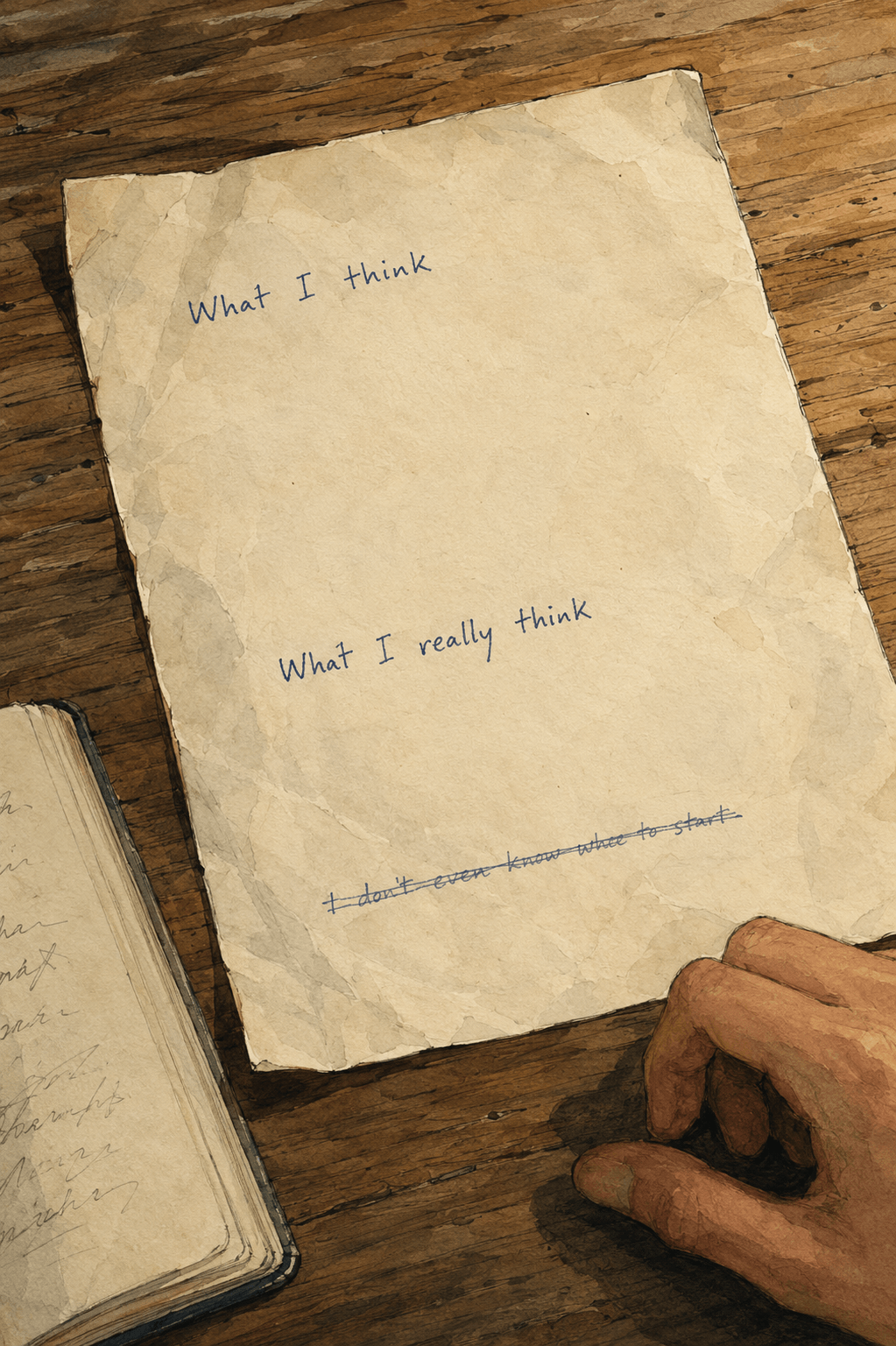
Gilligan’s research found that girls ages 7–10 are typically confident, direct, and “outspoken.” They say what they see and know without much self-editing. The shift happens at adolescence, when girls hit what Gilligan calls “the wall of Western culture”: the cultural ideal of the good, nice, selfless woman. To stay in relationship and be seen as likable, girls learn to trade honest voice for relational safety.
What they do instead: they say “I don’t know” when they do know. They defer, soften, and go quiet on things they actually have clear opinions about. Gilligan calls this going “underground” — not losing the self, but losing the belief that the self can be spoken and still be loved.
Judy Chu’s research observed preschool-age boys directly and found something that complicates the “boys just aren’t relational” stereotype. At age 4, boys are actually highly attuned — perceptive, emotionally literate, relationally sharp. But by kindergarten age, they’re already learning to mask that attunement to fit a cultural script of masculinity (the “boy code”: toughness, independence, not needing anyone).
What they do instead: they perform stoicism and self-sufficiency. Instead of naming an emotional or relational truth, they act — physically, through bravado, through “I don’t care” or “I don’t need that” — even when Chu’s observations showed they clearly did notice, feel, and care. The loss isn’t a loss of relational capacity; it’s a loss of the permission to show it.
Both losses are adaptive responses to relationship, not individual failures. Girls silence perception to stay likable; boys silence feeling to stay “manly.” In both cases the honest voice doesn’t disappear — it goes underground, and the cost is a slow disconnection between what they know/feel and what they let themselves say.
2. How the Honest Voice Is Nurtured
Gerhard Molin:
Nothing I’m about to share is offered as fact or truth. It’s a reflection of what I’ve noticed across a life lived in seven countries, studying with shamans, plant medicine practitioners, monks, therapists, coaches, and, most instructively, with perfectly ordinary people, much like you.
My path here hasn’t been much of a path, really. More like a dance that got a little more awake, and a little more participatory, as the years went on. The same dance you’re in, actually, in the sense that we’re all moving to the same song, whether or not we’ve noticed the music yet.
Every time I’ve expressed my honest voice, through my actual voice, my hands, my body, I’ve woken up to it a little more, and remembered it a little more. Over time I noticed three parts of this that are less like stages and more like organs, constantly feeding each other: waking up and staying awake, remembering (going inward, toward the emotions and the intuition), and expressing.
It helps to picture a tree. The roots are waking up. The trunk is remembering. The branches and the leaves are expression.
If the roots fall short, everything above them falls short too, which is really just another way of saying this was never a three-step process with a finish line; it’s a lifelong practice, or maybe just a lifelong way of paying attention. There’s nothing to upgrade here, no better version of you waiting past stage three. It’s a constant inquiry, starting at the root, moving up through the trunk, expressed finally through the leaves.
And here’s the part I only understood properly once I stopped trying to do it alone.
Expression isn’t the end of the loop. It gets a response, and that response travels all the way back down to the root. By expressing, you inquire. Through inquiry, the root system grows

But the response doesn’t have to come from inside you. Sometimes it can’t. Sometimes the only way to actually hear your own honest voice is to have someone else reflect it back to you, more clearly than you’re able to hear it alone.
Which is where this stops being a solitary practice.
Dr. Nicole Ohebshalom:
Part of nurturing the honest voice is locating it.
When a child retreats into vagueness, deflection, or “I don’t care” then we tend to treat that as a cue, not a dead end - we get curious. The adult women this version isn’t a dramatic silencing — it’s a well-practiced reflex: deferring before you’ve registered your own opinion, agreeing before you’ve checked if you agree. For adult men who’ve gotten so good at performing self-sufficiency that they’ve lost real-time access to needing anything — not lying, just no longer checking. When adults begin saying, “I don’t know” then I tend to ask myself and clients - what don’t you know. This is when the voice wants to hide. Ask yourself again, differently. Make space for the less socially tidy answer instead of accepting the first smooth one.
This voice isn’t recovered through solitary self-knowledge. It comes back inside relationships that can tolerate it. For adults this means: the work isn’t just “figure out what you really think” in isolation, it’s finding out (often by testing it) whether a specific relationship can survive you saying it. Couples, friendships, and — by extension — teams either become places where honest voice is safe again, or they re-enact the original bargain (stay likable/tough, stay connected; be honest, risk the bond).
3. Finding Your Voice In Relation With Others
Dr. Nicole Ohebshalom:
By the time we reach adulthood, most of us have gotten so fluent in translating what we feel into what’s palatable that we’ve stopped noticing we’re doing it. Carol Gilligan’s research on adolescent girls found the moment this trade gets made — trading honest voice for relational safety, learning to say “I don’t know” when you do know, “it’s fine” when it isn’t — but the trade doesn’t end at twelve. It just gets quieter, more practiced, more indistinguishable from personality. The polished diplomacy we praise in adults, the composure we reward in leaders, the agreeableness we call being “easy to work with” — these are often just the adult dialect of that same adolescent bargain, dressed up as maturity instead of named as a cost.
What Gilligan’s work makes clear is that voice isn’t recovered through insight alone — it comes back to life inside relationships that can actually hold it. You don’t think your way back to honesty in isolation; you find out, by risking it, whether a specific marriage, friendship, or team can survive you saying the unedited thing. This is why so many adults can articulate exactly what they think in therapy and still go silent at the dinner table or in the boardroom — the missing piece was never clarity, it was evidence that truth wouldn’t cost them the bond. Which means the real work of reclaiming voice in adulthood isn’t a solo project of self-discovery. It’s a test, run in real relationships, of whether connection and honesty can finally coexist — and often, the first step is simply noticing the half-second gap between what you feel and what you’re about to say, and choosing, just once, to close it.

Gerhard Molin:
“Don’t let the noise of others’ opinions drown out your own inner voice; have the courage to follow your heart and intuition, because they somehow already know what you truly want to become.” - Steve Jobs
It’s true. It’s also one of those truths that sounds almost insultingly simple the moment someone says it out loud, as if the only thing standing between you and your honest voice was never having heard the advice before.
Except you have heard it before. Probably a hundred times, and it hasn’t made the doing of it any less terrifying, because a feeling with no argument behind it, no research, no committee of people nodding along, is a genuinely frightening thing to follow, especially when the part of you that learned to perform has spent years building a very convincing case for why the feeling should wait until it can defend itself first.
I’ve spent fifteen-plus years testing this the hard way. Retreats, ceremonies, coaching sessions, rooms full of people crying and breaking open and swearing; this time, they’d actually live differently. And for a weekend, or a week, you do. You come out lighter, clearer, more like yourself than you’ve felt in months. And then you fly home, Monday shows up exactly where you left it, and there’s no one around you who was in that room, no one who watched you find the thing, no one to notice if you let it go again by Thursday. The insight was never the hard part. Integration was. And integration, it turns out, is not something you can do alone in an apartment with a journal, no matter how good the retreat was.
Which is maybe why this was never meant to be a solo project, but always in relation with others, starting with yourself, and a strong community.
4. The Honest Voice in Creativity
Dr. Nicole Ohebshalom:
Honest voice and creativity run on the same wiring. Both depend on the same act: saying the true thing before you’ve had time to make it acceptable. Creativity isn’t a separate talent some people have and others don’t. It’s what’s left over when honest voice hasn’t been trained out of you. The gap that determines whether someone can make anything genuinely original is the same gap that determines whether they can say what they actually think — the space between the raw perception and the pre-approved version of it.
Most people don’t lose this all at once. It erodes slowly, usually starting long before adulthood, as staying safe in relationships comes to feel more urgent than staying honest in them. Somewhere in that trade, the instinct to soften, hedge, or preempt gets faster and faster until it’s running before the original thought even finishes forming. This is why so many adults describe “losing their creative edge” with no real drop in skill. What’s actually gone isn’t ability. It’s nerve: the willingness to put forward the answer before checking if it’s the right one.
And it’s why creativity comes back, when it does, under a very specific condition: a relationship or space that can hold the unedited thing without flinching. A good collaborator. A good workshop. A good marriage. What they share isn’t technique, it’s tolerance. They make it safe to say the version that hasn’t been smoothed yet, which is usually the only version worth saying.
Bad creative environments do the opposite. Like bad relationships, they reward the polished, expected, safe answer and what atrophies is nerve, not talent. Which means the fix isn’t trying harder to be creative. It’s finding, or building, a relationship where the unedited first thought is allowed to exist long enough to be looked at - before the trained instinct smooths it into something safer and smaller.
Gerhard Molin:
There’s a difference between asking what can I build and asking what wants to be built, and it’s a bigger difference than it first appears.
The first question comes from the intellect, and the intellect is a genuinely useful instrument, precise, disciplined, capable of enormous things. Most of us have been trained almost exclusively in this register, because school and work and modern life reward it, it’s measurable, it’s productive, it looks good on a resume.
But the intellect can only rearrange what it already knows. It can optimize, refine, solve. What it cannot do, no matter how hard it tries, is originate the thing that hasn’t existed yet.
That second question, what wants to be built, comes from somewhere else. Rick Rubin calls it the Source 2, the field every idea is already floating around in, waiting for someone quiet enough to notice it. Steven Pressfield spent an entire book naming the thing that stands between you and it, Resistance, the very reasonable-sounding voice that always has a good argument for why not today 3.
I don’t think we invent our best ideas so much as we become still enough to receive them. Every artist knows the feeling of the muse visiting, and every artist also knows how rarely the muse visits a mind that’s busy performing, optimizing, achieving, all the things the other voice is so good at.
Which is why the honest voice matters here specifically, and not just as a nice-to-have alongside creativity. It’s the actual instrument the Source plays through. Tune the instrument, and the signal comes in clearer. Keep performing on it instead, and you’ll still make things, plenty of people do, but they’ll have that same flat, produced quality the dishonest voice always has, technically competent and quietly hollow.
And the ideas that do arrive this way tend to ask something uncomfortable of you: they sit right at the edge of what you currently know how to do, not comfortably inside it. That edge is where the growth actually happens, and it’s also, not coincidentally, exactly where the honest voice is hardest to trust and easiest to abandon.
Which is really the whole argument of this piece, looped back on itself. The impossible thing doesn’t get created by the person with the most discipline, or the cleverest strategy. It gets created by the person who got quiet enough to hear what wanted to exist, and honest enough to bring it into the world exactly as heard, unpolished edges and all.
It starts with knowing yourself
So maybe that’s the actual answer to where any of this starts, whatever “this” happens to be for you today. Not with a five-year plan, or a better morning routine, or the next skill to optimize.
With knowing yourself. With the voice underneath the one that learned to perform. With getting quiet enough, and brave enough, and, it turns out, connected enough to other people, to let it speak first.
The rest, apparently, tends to follow.
Ask yourself every day:
Am I living from my honest voice?
And feel how your body reacts, and peel away layer by layer until you reach the core of your being - your honest voice.
Cummins, N., Scherer, S., Krajewski, J., Schnieder, S., Epps, J., & Quatieri, T. F. (2015). A review of depression and suicide risk assessment using speech analysis. Speech Communication, 71, 10–49.
Rubin, R. (2023). The Creative Act: A Way of Being. Penguin Press
Pressfield, S. (2002). The War of Art: Break Through the Blocks and Win Your Inner Creative Battles. Warner Books.
 | A guest post by
|