
How a Google Meet Became a Lighthouse Horror Story
What a three-hour Dungeons & Dragons session taught us about building genuine connection through a screen.

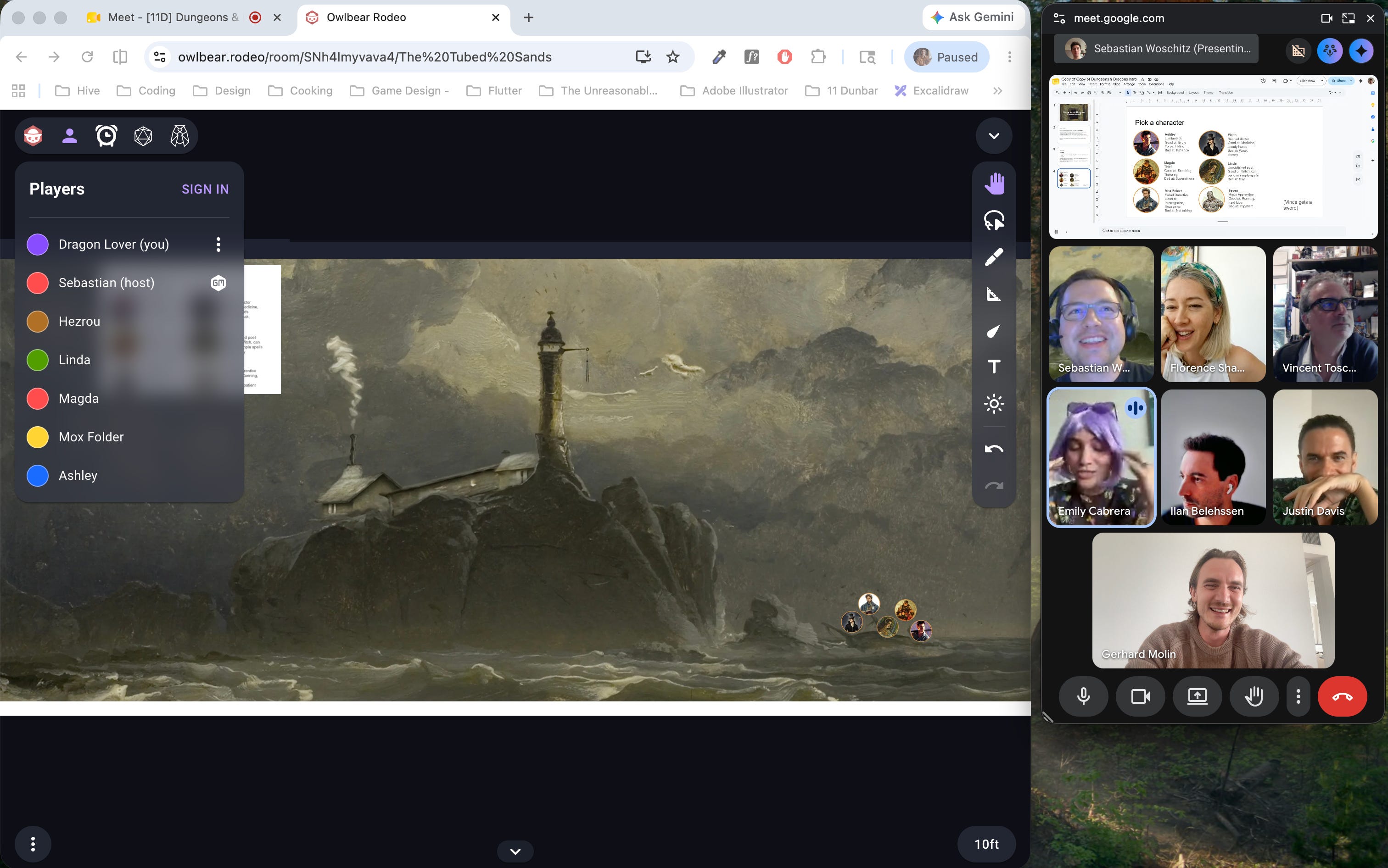
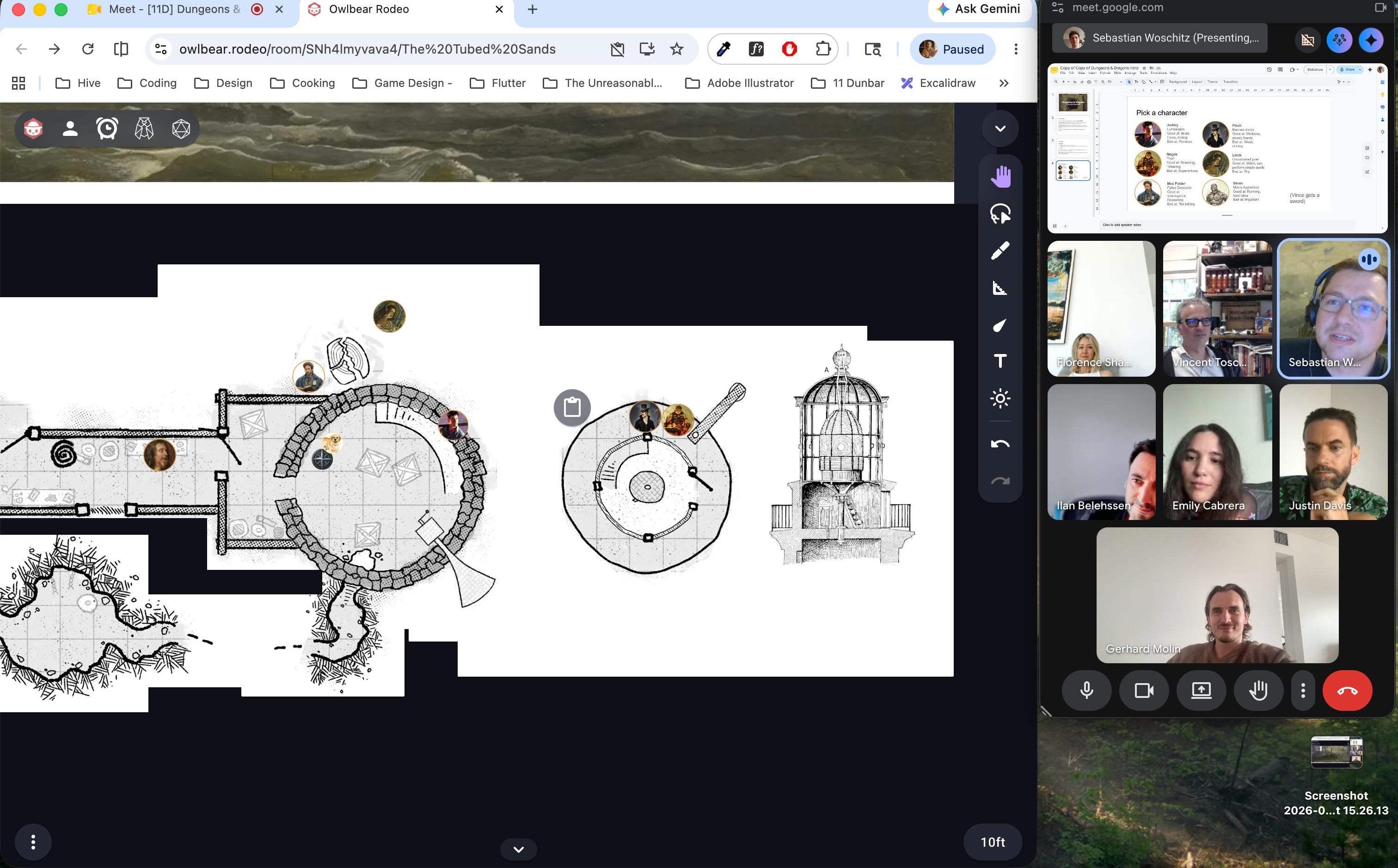
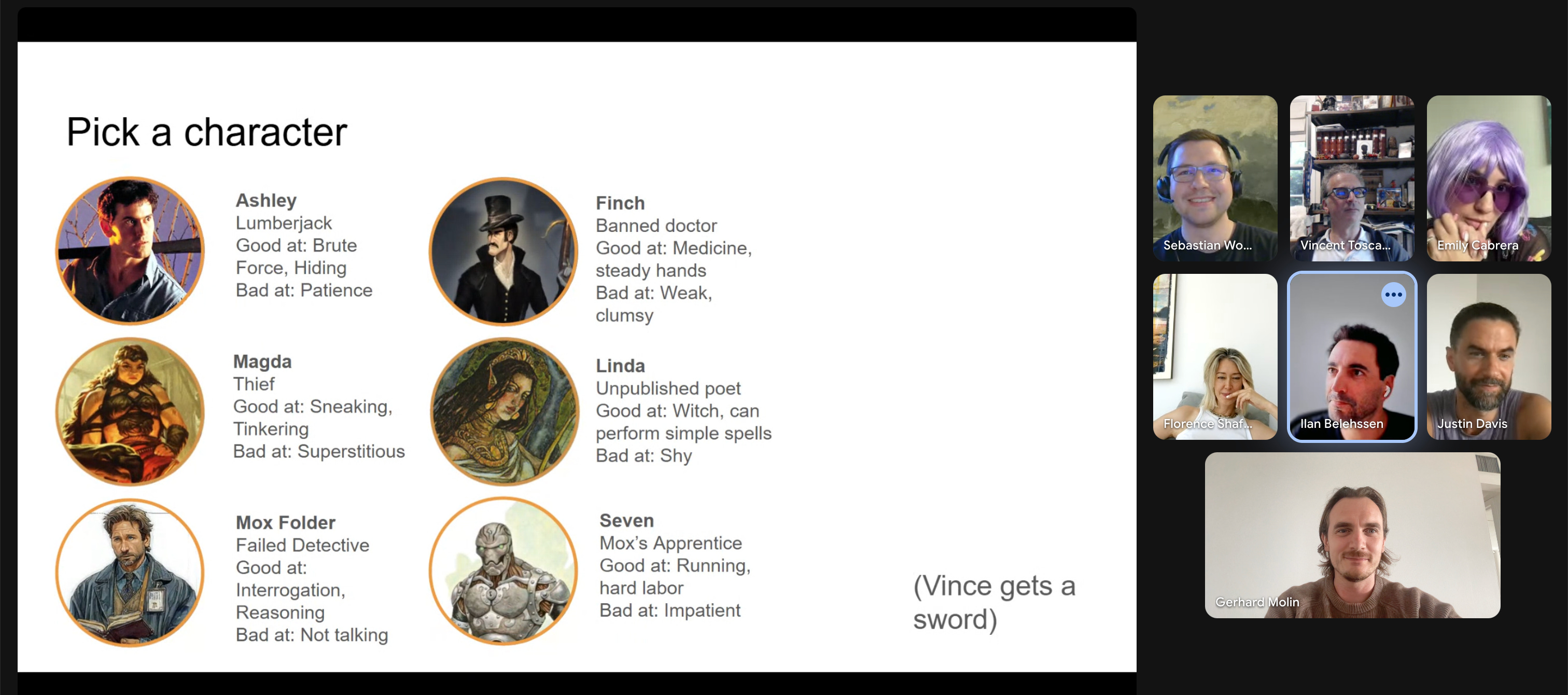
It was a wild and stormy night when Ashley the Lumberjack, Finch the Banned Doctor, Magda the Thief, Linda the Unpublished Poet, and Mox Folder the Failed Detective approached an island with a mysteriously looking lighthouse on a rocky and hole-ridden boat. They were shivering, strangers in a boat bound by a common mission: reach the lighthouse and find out what was going on.
Little did they know of the horror that was taking place on the island, but soon they would find out, and it would even cost Ashley the Lumberjack his life in an epic battle - a pure act of bravery so others could live. All combined with a never-ending stream of laughter and silliness.
These are not real people, but characters played by our Eleven Dunbar founding members Emily (Ashley), Vincent (Finch), Florence (Magda), Ilan (Mox Folder), and co-founder Justin Davis (Linda). It may just look like another Google Meet meeting, but it was a three-hour co-created adventure that transcended time & space, and bound them together through the vehicle of play.
It didn’t matter that it was purely digital, and it didn’t require a special physical location or fancy technology (although Google Meet is quite something if you think about it) - it required presence, curiosity, and the magic behind play.
So, what is the magic behind play that allows for genuine human connection and creativity, and can make digital meaningful (again)?
What Dungeons & Dragons Actually Is
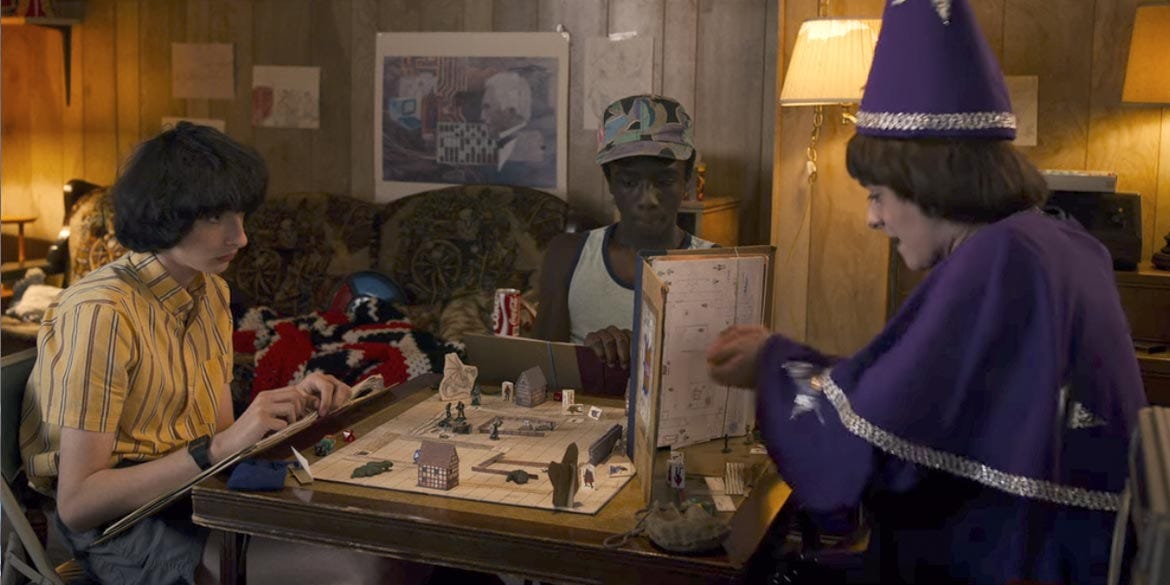
If you have never played, the easiest way to picture it is this: Dungeons & Dragons is a story you build together out loud, with no screen full of graphics, just a handful of people and their imaginations.
One person, the Game Master, narrates the world into being, describing what you see, playing everyone who isn’t you, and telling you how the world answers back. While everyone else plays a single character living inside that world, deciding what they would do, what they would say, and where they would go, as if they were truly there.
The game loop is simple:
The Game Master says what’s happening.
The players talk it over and decide what to try, and then it all begins again.
Whenever something is genuinely difficult or risky, the dice get the final word: a low roll for misfortune, a medium one for the messy in-between, a high one for things in your favor.
There is no winning here, no finish line to cross, only the invitation to be curious, to investigate, to look after each other, and, ideally, to survive.
You may know Dungeons & Dragons (D&D) from the cult series Stranger Things, but it dates way back to 1974, when Tactical Studies Rules published it. There are many ways to play D&D, and it can look frankly quite intimidating with rulebooks & character sheets thick enough to prop open a door. Which is why we got Sebastian from rolltothink to be our Game Master, who masterfully strips the experience to its essence: pure storytelling, giggles, silliness, and imagination.
Because underneath all the rulebooks and dice, the thing itself is astonishingly simple; a reminder of what we are capable of through shared storytelling, that we are all, every one of us, wildly imaginative beings able to conjure whole worlds together with nothing more than conversation.
Can the Digital Be Meaningful (Again)?
We live in a world that is as connected as it has ever been and also, somehow, as lonely, and the usual response is to point at the screen and say there is your culprit, and as if the solution were simply to step away, to go outside, to find a third/fourth place, to rebuild in person what the digital world has quietly hollowed out.
I do not want to dismiss that impulse, because there is something that moves me about the co-working spaces, co-living arrangements, and co-playing communities that have been quietly popping up over the last decade in cities.
It’s almost a renaissance of remembering we were always meant to share space and that the architecture of modern life has made that harder than it should be, and I find it exciting to see them popping up.
But I also think we misread the loneliness problem when we point at the technology rather than at our relationship with it, how we use it, with what intention, in what kind of setting, because the technology is not doing anything to us that we have not asked it to do.
And there is a more practical problem with the in-person answer, which is that these spaces exist, almost without exception, in cities, which are available primarily to people who choose to live in cities.
Yet, we know that physical distance between people has nothing to do with loneliness:
“The explanation, I suppose, is that the physical distance between people has nothing to do with loneliness. It’s psychic distance, and in Montana and Idaho the physical distances are big but the psychic distances between people are small, and here it’s reversed. Technology is blamed for a lot of this loneliness, since the loneliness is certainly associated with the newer technological devices-TV, jets, freeways and so on-but I hope it’s been made plain that the real evil isn’t the objects of technology but the tendency of technology to isolate people into lonely attitudes of objectivity.” - Zen and the Art of Motorcycle Maintenance, Robert M. Pirsig
Consider the parent who chose remote work so they could be home when their child comes through the door, and who now wants to pursue meaningful work without wasting hours of commute every day, or being stuck in an office.
Or the digital nomad who moves every few months and is therefore perpetually three days away from having a real community wherever they happen to be.
Or the solopreneur running something small and ambitious from a market town that has no co-working space and no plans to build one.
We have learned that these people are in as much need of genuine connection, play, and creative nourishment as people who live in cities, and to focus on reducing the psychic distance, rather than the physical distance.
So the question I keep returning to is not whether the in-person world has good things to offer, it obviously does, but whether the digital space can be built with enough intention and enough structure to carry the thing that connection actually runs on.
Perhaps we have been asking the wrong question all along, blaming the screen for what is really an absence of the right kind of frame.
What is going on here?
Play has been studied extensively and has been part of humans since the dawn of time. Play as a vehicle to learn, connect, create, or navigate life.
When I studied game design, I read Huizinga's work Homo Ludens1, where he talks about how play happens inside a special, temporary world with its own rules, set apart from ordinary life. He coined it the magic circle - it is a beautiful image, and I have never stopped using it in conversation, but I always found it hard to describe what is actually happening inside the circle, or what breaks the magic of this circle.
It was when I stumbled upon Erving Goffman’s Frame Analysis2 that I found the concept I had been looking for, because Goffman starts from the simplest possible question: what is going on here?
A frame is what answers that question in any given situation, the invisible context that tells everyone present what the rules are, what roles are available, and what behaviour is expected, not something invented fresh each time but already embedded in the social context, waiting for people to step into it, often without realising that is what they are doing.
I’d argue that a frame is not only something that is always already embedded, but can be designed and engineered to create a certain feeling, or state of being3.
This is why game designers are masters of designing playful frames, which allow people to step out of their day-to-day persona, and suddenly turn into hyper-curious and resilient learners/adventurers, who eat failure for breakfast, but also connect through shared play.
Consider what happened to Google Meet on that Friday night. For most of us, it carries a particular weight: the platform of the pandemic, of the back-to-back calls, of the muted microphone, and staring into the middle distance. For many, not a place to be intellectually, creatively, and emotionally nourished.
However, nothing about the software changed when Sebastian opened the session: the same grid of rectangles, the same mute button, the same slightly unflattering angle.
But the frame changed entirely, the rules were different, the roles were different, the behaviour expected of everyone in those rectangles was different, and so Google Meet stopped being a place where you report on your quarterly objectives and became, for three hours, a lighthouse on a stormy island where something terrible was about to happen.
That is what a frame designed for play, creativity, and connection does, and it is why Gary Alan Fine, in his work Shared Fantasy, decided to look very closely at what was happening around ordinary tables where ordinary people were playing Dungeons & Dragons4.
What Fine noticed was that everyone playing is quietly holding three selves at once:
The person they actually are.
The player who knows it’s a game and weighs the odds.
The character living inside the story.
The whole fragile thing only works because everyone agrees to keep all three in the air at the same time, which is, when you think about it, a small miracle of coordination dressed up as a Friday-night hobby.
So, the question arises then, do these experiences live separately from the ordinary day-to-day frame, or do they bleed into each other? And does the bleeding allow for actual meaning and genuine connection, so it outlives the game and positively influences ordinary life?
Sarah Lynne Bowman5, a researcher who has spent years studying what actually happens to people inside roleplaying games, calls it bleed: the emotional spillover between the player and the character, the moments when what the character is feeling begins to colour the person playing them, and what the person is feeling finds its way into the choices the character makes.
It is neither a malfunction nor something to be avoided, and for many players it is precisely the point, the place where the pretend world and the real one stop running parallel and start, quietly, to become one.
Which is exactly what happened when Emily decided, somewhere in the middle of a lighthouse horror story on a Google Meet, to have her character, Ashley the Lumberjack, sacrifice his life by battling the strongest opponent in the game, so the rest of the party could live.
She wasn’t only making a tactical call inside the game, she was choosing, as herself, to give something up for the people in the other rectangles on her screen, and the feeling in the room in that moment, the hush, and then the laughter breaking through, wasn’t quite the feeling of watching a fictional character do a fictional thing, it was closer to the feeling of watching someone actually be brave, which is a strange and warm thing to experience on a Friday night through a video call.
And if that weren’t enough, Emily also spent a considerable portion of the session attempting to destabilise Sebastian, our Game Master, with a relentless cheerful silliness that was very much her own and that leaked into every choice Ashley made, which is bleed moving in the other direction, the real person colouring the character, and somehow making the whole thing more alive rather than less.
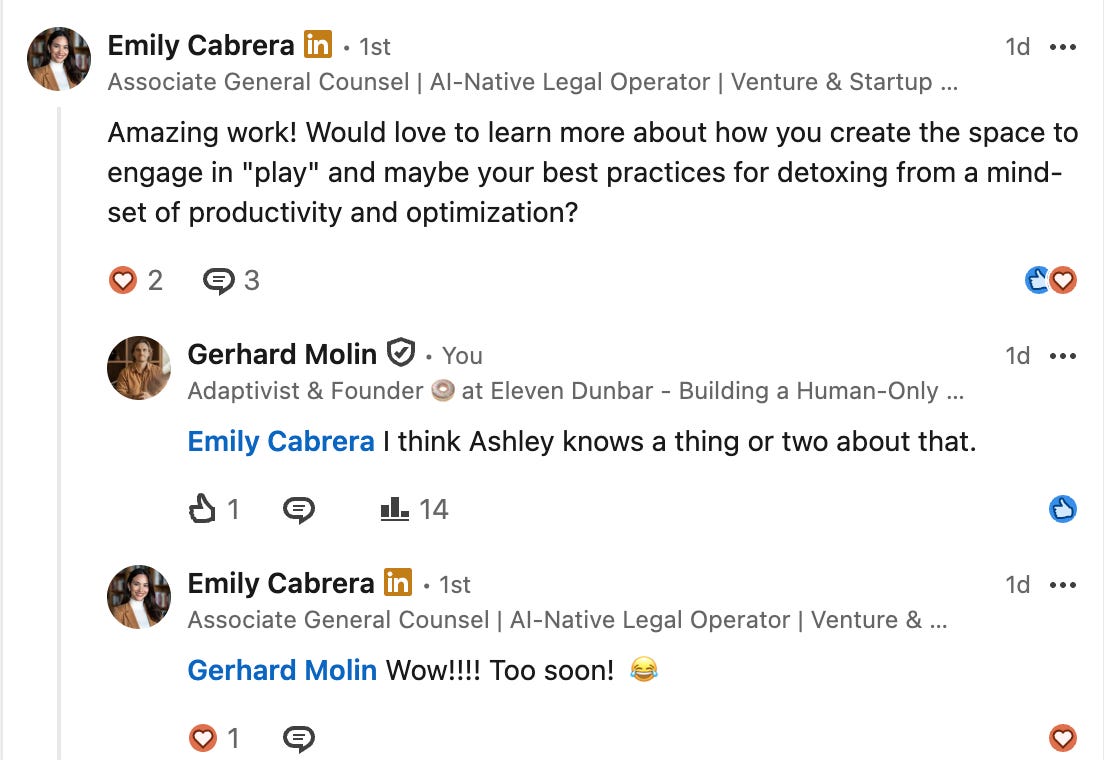
Ashley the Lumberjack has been a running thread at Eleven Dunbar ever since, a shared reference that surfaces between people who were there and people who have only heard the story, and what strikes me about that is that the thing being remembered is not a dice roll or a game mechanic:
It is a human moment, an act of generosity dressed in fiction that outlasts the session.
The frame held for three hours on a Google Meet, and what moved between the frames, the laughter, the bravery, the silliness, the grief that wasn’t quite grief, was entirely, unmistakably human.
The medium, the technology, the digital-only, it turned out, had nothing to do with it.
A Human-Only Internet For Genuine Connection and Creativity
In my last article Don’t Panic, Be Playful I reignited my hunger to understand play, and to show, rather than tell, how to bring more playfulness into one’s life, in the hope of making it less of a philosophical discussion, but an action-oriented way of living.
To actually help people navigate their life better, to breathe better, to parent better, to create authentically, to laugh harder, and to be seen and see others fully.
Something I have been missing dearly in the spiritual circles, where it has become more of an intellectual exercise than a grounded embodiment practice to help people navigate life better.
Not only is play, combined with interdependence, an incredibly powerful vehicle for genuine connection and creativity, but also an antidote against the inner battles (Resistance6) that stand between you and your soul’s creative purpose.
So, if this is true, then I firmly believe that technology, or the digital space, has never been the root problem of today’s consumer culture that is more lonely that ever.
It has been our relationship with technology, especially the Internet, that has made us more disconnected from ourselves and, therefore, from each other. And as a result, disconnected from our soul’s creative purpose.
And don’t get me wrong, in real life, experiences and connections can never be fully replaced. Replacing in real life was not the goal of creating a human-only Internet for genuine connection and creativity, but the possibility of the Internet as a place where genuine connection and creativity lead to real life - that is what gets me excited.
Technology used with enough intention that the connections formed through a screen eventually find their way off it, into a meal, into a room, into a life.
Because the one ingredient connection actually runs on is not proximity, it is presence and the felt sense of actually being with someone inside a shared world, and that, as a fictional lumberjack on a Google Meet once proved, travels perfectly well through a screen.
Thus, a digital container built with enough intention is a real answer for the parent at home, the nomad, or any person three hours from a city, who experiences psychic loneliness.
Eleven Dunbar is our attempt at it, to create a human-only internet for genuine connection and creativity, capped at 150 people.
A place where we help each other overcome the Resistance to discover and express our soul’s creative purpose.
Even if, occasionally, it costs Ashley the Lumberjack his life.
Huizinga, J. (1949). Homo Ludens: A Study of the Play-Element in Culture. Routledge & Kegan Paul.
Goffman, E. (1974). Frame Analysis: An Essay on the Organization of Experience. Northeastern University Press.
Molin, G. (2017). The Role of the Teacher in Game-Based Learning: A Review and Outlook. In Ma, M. & Oikonomou, A. (Eds.), Serious Games and Edutainment Applications, Vol. II (pp. 649–674). Springer. https://doi.org/10.1007/978-3-319-51645-5_28
Fine, G. A. (1983). Shared Fantasy: Role-Playing Games as Social Worlds. University of Chicago Press.
Bowman, S. L. (2010). The Functions of Role-Playing Games: How Participants Create Community, Solve Problems, and Explore Identity. McFarland
Bowman, S. L. (2015). Bleed: The spillover between player and character. Nordic Larp. https://nordiclarp.org/2015/03/02/bleed-the-spillover-between-player-and-character
Pressfield, S. (2002). The War of Art: Break Through the Blocks and Win Your Inner Creative Battles. Warner Books.
Thanks for reading it would mean a lot if you share it.
AI has been used to refine structure, grammar, and flow, but every idea, word, sentence, and story originates from human experience and intuition.
This resonates deeply, Gerhard. Thank you for this lovely article.
As always, so well written!! I’m looking forward to the next DnD campaign as well as designing unique experiences with our community that facilitate more creativity and deeper connections.